Best Ryokans Kyoto 2026: The Complete UK Traveller’s Guide by Budget and Neighbourhood
Prices in this guide are indicative only, based on publicly available listings researched in May 2026, rates updated August 2026. All prices are converted from Japanese Yen at approximately £1 = ¥212 (August 2026 rate). Exchange rates and hotel prices fluctuate daily. Prices shown include dinner and breakfast unless stated otherwise. Always verify current rates before booking. Full disclaimers below ↓
Editorial note: This guide was produced by the GlobalStay editorial team to help UK travellers plan a Hokkaido ryokan stay. GlobalStay sources ryokan and hotel accommodation across Japan for UK travellers — submit a quote request and we respond within 24 hours. We do not sell flights or Umrah packages.
Loading…
Rates update automatically on every page load. Indicative mid-market rates only — always verify before booking.
Best onsen districts: Noboribetsu, Jozankei, Lake Toya, Sounkyo Gorge, Hakodate Yunokawa.
Mid-range ryokan: From £75 per person per night including dinner and breakfast.
Private onsen ryokan: From £142 per person per night including meals.
Luxury ryokan: From £236 to £755+ per person per night including meals.
Best season from UK: February (powder snow and onsen), July–August (lavender, hiking), October–November (autumn foliage).
Getting there: Fly London to New Chitose Airport (Sapporo) via Tokyo — approximately 13 to 16 hours total.
Book ahead: Winter (Dec–Mar) 2 to 3 months minimum. Top luxury ryokan 6 to 12 months.
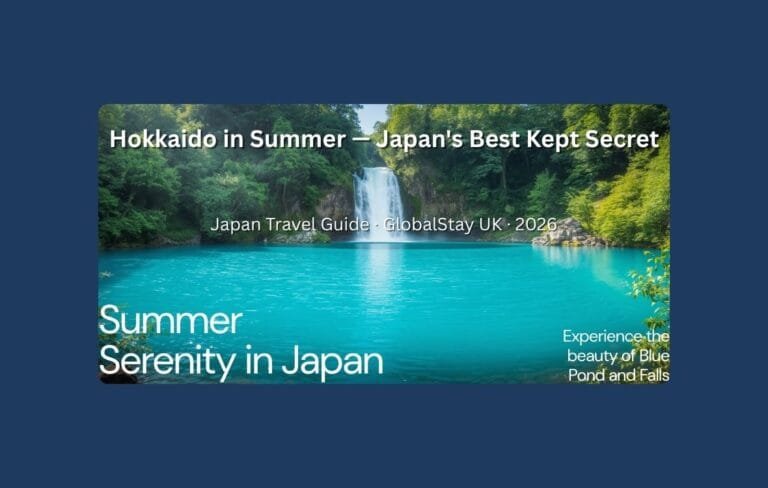
Hokkaido is Japan’s northernmost island — bigger than Ireland, geologically volatile, and home to a ryokan culture built on volcanic hot spring water that flows from the earth across dozens of distinct onsen districts. Most UK visitors never get this far north. They stop in Tokyo, Kyoto, and Osaka. That is their loss and your opportunity.
A Hokkaido ryokan stay in 2026 offers something no other Japanese destination delivers in the same combination: genuine wilderness, volcanic onsen, exceptional food, and real privacy. The island’s cuisine alone — Hokkaido crab, sea urchin pulled that morning, dairy from farms in sight of your window, Yubari melon — justifies the journey. The hot springs are the reason you stay. This guide covers every onsen district worth knowing, real GBP prices in clear tables, and exactly what to book and when.
Hokkaido ryokan onsen districts — what makes each one different
Unlike Hakone or Kyoto where geography concentrates ryokan into one area, Hokkaido spreads its onsen across a vast island. Each district has distinct spring chemistry, landscape character, and the right type of traveller. Choose your district before you choose your ryokan.
Hokkaido ryokan 2026 — prices in GBP by district and category
All prices per person per night, including dinner and breakfast unless stated. Converted from JPY at £1 = ¥212 (August 2026). Prices are indicative only — check current rates before booking. Low season = spring/autumn weekdays. Peak season = winter school holidays, Golden Week, August.
| District | Ryokan | Category | Low season (£/pp) | Peak season (£/pp) | Private onsen |
|---|---|---|---|---|---|
| Noboribetsu | Dai-ichi Takimotokan | Large resort ryokan | £80–£113 | £132–£189 | Shared only — 35 bath types |
| Noboribetsu | Ryotei Hanayura | Traditional ryokan | £123–£170 | £189–£264 | Select rooms |
| Noboribetsu | Bourou Noguchi Noboribetsu | Luxury contemporary | £189–£264 | £302–£425 | Most rooms |
| Jozankei | Hana Momiji | Mid-range ryokan | £75–£113 | £132–£179 | Reservable (kashikiriburo) |
| Jozankei | Grand Blissen Hotel Jozankei | Luxury ryokan hotel | £132–£189 | £217–£302 | In-room onsen available |
| Lake Toya | Lake View Toya Nonokaze Resort | Luxury lake view | £151–£217 | £264–£377 | In-room private onsen |
| Lake Shikotsu | Lake Shikotsu Tsuruga Bessou Ao no Za | Ultra-luxury | £330–£472 | £472–£708 | Every suite |
| Niseko area | Zaborin Ryokan | Ultra-luxury (15 villas) | £377–£519 | £566–£755+ | Every villa — indoor + outdoor |
| Hakodate Yunokawa | Kappo Ryokan Wakamatsu | Traditional ryokan | £85–£123 | £142–£208 | Reservable baths |
| Hakodate Yunokawa | Bourou Noguchi Hakodate | Luxury — panoramic views | £189–£283 | £302–£425 | Private floor onsen |
| Sounkyo Gorge | Sounkyo Kankou Hotel | Mid-range gorge views | £75–£113 | £123–£189 | Shared — gorge-view baths |
| Otaru | Hotel Neuschloss Otaru | Mid-range ocean view | £94–£142 | £151–£208 | In-room private onsen |
⚠️ Prices are per person per night including kaiseki dinner and breakfast unless noted. Converted from JPY at £1 = ¥212 (August 2026). Actual rates vary by room type, season, day of week, and availability. Prices are indicative only and do not constitute a confirmed booking. Always request a current quote. Sources: Booking.com, Tripadvisor, selected-ryokan.com, property websites — August 2026.
The five Hokkaido onsen districts — what each one delivers
Noboribetsu — most dramatic, most accessible
Noboribetsu is 90 minutes from Sapporo by express train and is where most first-time Hokkaido ryokan visitors start. The Jigokudani volcanic crater — Hell Valley — produces steam year-round, the ground hisses, and nine distinct spring types flow through the district. Dai-ichi Takimotokan’s 35 bath types make it feel more like a thermal park than a traditional inn. For atmosphere and genuine ryokan character at a lower price point, Ryotei Hanayura is the better choice. Bourou Noguchi Noboribetsu is the district’s finest property — private open-air onsen, superb kaiseki, far fewer guests.
Jozankei — Sapporo’s onsen escape, autumn foliage capital
Jozankei is where Sapporo residents go for a weekend ryokan break. Fifty minutes by bus from central Sapporo, the valley sits along the Toyohira River with mountains on three sides. Autumn foliage in late October is exceptional. Hana Momiji suits UK travellers who want genuine ryokan character without paying for the top tier. Grand Blissen Hotel Jozankei is the luxury choice — in-room onsen, polished kaiseki, elegant rooms. Both are within easy reach of Sapporo’s Chitose Airport for arrival and departure days.
Lake Toya — volcanic lake views and special occasions
Lake Toya is a caldera lake two hours from Sapporo, formed by volcanic collapse. Ryokan here position rooms to face the lake — Mount Usu, which last erupted in 2000, is visible from many baths. Lake View Toya Nonokaze Resort is the standout property: all 80 rooms face the lake, each has a private open-air onsen on the balcony, and the top-floor public baths deliver one of the finest soaking views in Hokkaido. This is a special occasion property — anniversaries, honeymoons, milestone birthdays.
Niseko and Zaborin — the most exclusive ryokan in Hokkaido
Zaborin sits near Niseko — Japan’s premier ski resort and increasingly known internationally for its deep powder snow. The ryokan has 15 villas only. Every villa includes both a private indoor hinoki cypress bath and an outdoor stone rotenburo. The water is gensen kakenagashi: drawn from nearly a kilometre underground, flowing directly to your bath without recycling or additives. There are no communal facilities. Bathing is entirely private by design. Zaborin costs from approximately £400 per person per night and requires booking 6 to 12 months ahead for winter. A 15-minute shuttle from Kutchan Station is included. This is the finest onsen ryokan experience available in Hokkaido and one of the finest in Japan.
Hakodate Yunokawa — tradition, seafood, and ocean onsen
Hakodate is in southern Hokkaido — four hours from Sapporo by Shinkansen, accessible as part of a Hokkaido circuit. The Yunokawa onsen district sits on the eastern coast, 30 minutes from Hakodate centre by tram. Kappo Ryokan Wakamatsu is the traditional choice: kaiseki dinners featuring Hakodate’s famous squid and seafood, tatami rooms, genuine hospitality. Bourou Noguchi Hakodate is the luxury option — four floors of private open-air onsen with panoramic city and port views, contemporary design, and multi-course kaiseki dinners combining Japanese and Western influences. In winter, Yunokawa’s onsen garden hosts snow monkeys bathing in the hot springs — a quieter, less crowded version of Nagano’s famous Jigokudani monkey park.
Best time to visit Hokkaido ryokan from the UK
The honest answer depends on what you want from the trip:
- December to March (winter onsen season): The signature Hokkaido experience — snow-covered landscapes, outdoor rotenburo baths steaming against frozen air, Niseko skiing. Noboribetsu and Jozankei are at their most atmospheric. Book 2 to 3 months ahead minimum. Zaborin needs 6 to 12 months. UK school holidays in February align well with peak Hokkaido snow conditions.
- Late June to August (summer): Lavender fields in Furano (peak mid-July), hiking in Daisetsuzan National Park, Hokkaido’s cool summer temperatures against Japan’s southern heat. UK school summer holidays overlap perfectly. Ryokan prices are lower than winter. Onsen bathing in warm weather is a different experience — outdoor baths face forest rather than snowscape, but the spring quality is the same.
- October to early November (autumn foliage): Sounkyo Gorge in October delivers some of the finest autumn colour in Japan, with red and gold maple leaves against the gorge walls. Jozankei foliage peaks late October. Popular and worth planning ahead — book ryokan 6 to 8 weeks before for this window.
- April to May (spring): Shoulder season. Prices are lower, crowds are smaller. Cherry blossoms arrive later in Hokkaido than the rest of Japan — Sapporo blooms typically in late April, making it possible to catch spring colour after the rest of Japan’s sakura season has finished.
Getting to Hokkaido from the UK — the practical guide
There are no direct flights from the UK to Hokkaido. The standard route is London Heathrow or Manchester to Tokyo (Narita or Haneda) via British Airways, Japan Airlines, ANA, or a Gulf carrier connection, then onward to Sapporo’s New Chitose Airport (CTS) by domestic flight (90 minutes) or by Shinkansen via the Hokkaido tunnel (approximately 4 hours from Tokyo). Total journey time is 13 to 17 hours depending on connection times.
New Chitose Airport connects to central Sapporo (Sapporo Station) in 36 minutes by the Chitose Line rapid train — straightforward and well-signposted in English. From Sapporo, express trains and buses reach Noboribetsu, Jozankei, and Lake Toya. For more remote districts like Sounkyo or eastern Hokkaido properties around Lake Akan, renting a car in Sapporo is the practical choice — public transport exists but requires long connections.
Private onsen ryokan — what UK travellers need to know before booking
Private onsen baths (known as kashikiriburo when reservable, or in-room baths in higher-tier rooms) are what most UK travellers specifically want when they say Hokkaido ryokan. The terminology matters:
- In-room rotenburo: A private outdoor bath on your balcony or terrace, filled with genuine onsen water. The most desirable option. Available at Lake View Toya Nonokaze Resort, Zaborin, Lake Shikotsu Tsuruga Bessou Ao no Za, and select rooms at other properties. Book these rooms explicitly — they are always the first to sell out.
- Kashikiriburo: A private bath that guests reserve by the hour. Shared across all guests but used exclusively by your group during your slot. Available at Hana Momiji (Jozankei), many Noboribetsu properties, and elsewhere. Usually available at no extra cost or a small supplement.
- Communal baths (konyoku or gender-separated): Standard across all ryokan. Large communal baths separate by gender. These are the heart of the traditional onsen experience. Tattoo policies vary — check before booking if relevant.
What to expect at a Hokkaido kaiseki dinner
Kaiseki dinner is included in ryokan pricing across Hokkaido and is typically the meal that stays with UK visitors longest. In Hokkaido, kaiseki leans heavily on what the island produces: Hokkaido king crab, scallops, sea urchin (uni) in season (June to August is peak), Yubari melon, wagyu beef from local farms, and dairy. Courses arrive one by one over 90 minutes to two hours. Most ryokan serve dinner in your room or a private dining space — communal dining halls are less common in Hokkaido’s mid-to-luxury tier than in other regions.
Halal and Muslim-friendly options are limited across Hokkaido ryokan. If this matters for your stay, enquire directly with the property before booking. A small number of Sapporo hotels can accommodate halal requests with advance notice. For Umrah travellers combining Japan with their pilgrimage planning, see our Makkah hotel guide and Madinah hotel guide for those elements of the trip.
How to book a Hokkaido ryokan from the UK
Most top Hokkaido ryokan list on Booking.com and their own English-language websites. For properties like Zaborin and Lake Shikotsu Tsuruga Bessou Ao no Za, booking direct is recommended — they hold the best availability and can confirm room-specific details including onsen type and view.
For UK travellers combining a Hokkaido ryokan stay with hotels in Tokyo, Osaka, or Kyoto, GlobalStay handles the full Japan hotel itinerary in one request — we source each property, check availability for your specific dates, and confirm options within 24 hours. Group bookings of four or more rooms receive negotiated rates that retail platforms cannot match.
What Is a Ryokan — Complete Guide for UK Travellers 2026
Best Ryokans in Kyoto 2026 — Prices, Locations, What to Expect
Japan Summer Holidays from UK 2026 — Hotel Guide
Hotels Near Haram Makkah 2026
Hotels in Madinah Near Masjid An-Nabawi 2026
Hotel Booking UK — All Worldwide Destinations
Get a Personalised Hotel Quote — 24-Hour Response
🏔️ Planning a Hokkaido ryokan stay? Request a quote from GlobalStay — we source ryokan across Noboribetsu, Jozankei, Lake Toya, Niseko and Hakodate for UK travellers and respond within 24 hours.
Written by the GlobalStay Editorial Team. GlobalStay is a UK registered hotel booking service operated by Ya-Fatahoo Solutions Limited (Company No: 16175087), incorporated in England and Wales. We source ryokan and hotels in Japan, Makkah, Madinah, Dubai, Istanbul, and worldwide destinations for UK travellers, families, and corporate clients. We are a hotel-only sourcing service and do not sell flight-inclusive packages or Umrah packages.
Full Disclaimers
Pricing accuracy: All prices in this guide are indicative only. They are based on publicly available listings researched in May 2026, rates updated August 2026 and converted from Japanese Yen at approximately £1 = ¥212 (August 2026 rate). Exchange rates fluctuate daily. Ryokan prices vary significantly by room type, season, day of week, number of guests, and availability. Prices shown do not constitute a confirmed booking or guaranteed rate. Always verify current rates directly with the property or via your booking platform before making any financial commitment.
Seasonal information: Season dates, foliage peak times, and festival dates referenced in this guide are based on historical patterns and publicly available information as of August 2026. Actual conditions vary year to year. Always check current conditions before booking non-refundable travel.
Tattoo policies: Onsen tattoo policies in Japan vary by property and change periodically. Always confirm current policy directly with the ryokan before booking if relevant.
Halal and dietary requirements: Halal-certified dining options at Hokkaido ryokan are limited. Always enquire directly with the property before booking.
Entry requirements: UK passport holders do not require a visa for Japan for stays of 90 days or fewer as of August 2026. Entry requirements are subject to change. Verify with the UK Foreign, Commonwealth and Development Office before booking travel.
Hotel booking: GlobalStay is a hotel-only sourcing service operated by Ya-Fatahoo Solutions Limited. We are not an ATOL holder. For flight-inclusive packages, use an ATOL-protected operator.
FTC disclosure (US readers): This guide may contain affiliate links. GlobalStay may earn a commission if you click and book at no additional cost to you.
Does not constitute legal, financial, or travel safety advice. Last updated: August 2026.