What is a Ryokan? The Complete Guide for UK Travellers 2026
What is a ryokan — Global Stay explains traditional Japanese inns for UK travellers in 2026, covering tatami rooms, onsen baths, kaiseki dining, GBP pricing, Muslim-friendly options and how to book a ryokan from the UK.
Prices are indicative and based on publicly available data as of April 2026, rates updated August 2026. Always verify current rates before booking. Full disclaimers below ↓
Editorial note: This guide was produced by the Global Stay editorial team to help UK travellers understand ryokan accommodation in Japan before booking. Global Stay sources ryokans and Japan hotels for UK travellers — submit a quote request and we respond within 24 hours.
Rates update automatically on every page load. All GBP prices in this guide calculated at £1=¥212 (August 2026). Indicative mid-market rates only — always verify before booking.
What is a ryokan — and why does every first-time visitor to Japan end up wishing they had booked one sooner? A ryokan is a traditional Japanese inn, and it is the single most culturally distinctive accommodation experience available in Japan. You sleep on a futon laid on tatami straw mats. You soak in a mineral hot spring before dinner. A kaiseki multi-course meal arrives at your low table, course by course, prepared from seasonal local ingredients. You wear a yukata cotton robe for the entire evening. Everything in a ryokan is designed around one concept: the complete restoration of a tired traveller.
Ryokan in English: Japanese Terms Explained for UK Travellers
If you searched for “ryokan in english”, you have come to the right place. A ryokan is a traditional Japanese inn. But that one sentence does not tell you what you actually need to know before booking one from the UK. Here is every Japanese word you will encounter, translated into plain English before you arrive.
📖 Ryokan in English — Quick Translation
Ryokan = traditional Japanese inn (tatami floors, futon bedding, often a hot spring bath)
Onsen = natural hot spring mineral bath
Kaiseki = multi-course Japanese dinner served in your room
Yukata = lightweight cotton robe worn around the inn
Futon = thick floor mattress laid out on tatami each evening
Tatami = woven straw floor covering (remove your shoes)
Kashikiri-buro = private reservable bath (essential for Muslim travellers)
Omotenashi = Japanese wholehearted hospitality
This guide translates every ryokan term you will read on booking websites, see on menus, and hear from staff. No Japanese language skills needed. Just bookmark this page and refer to it before you book your first ryokan from the UK. For a full list of properties, see our best ryokans Kyoto 2026 guide.
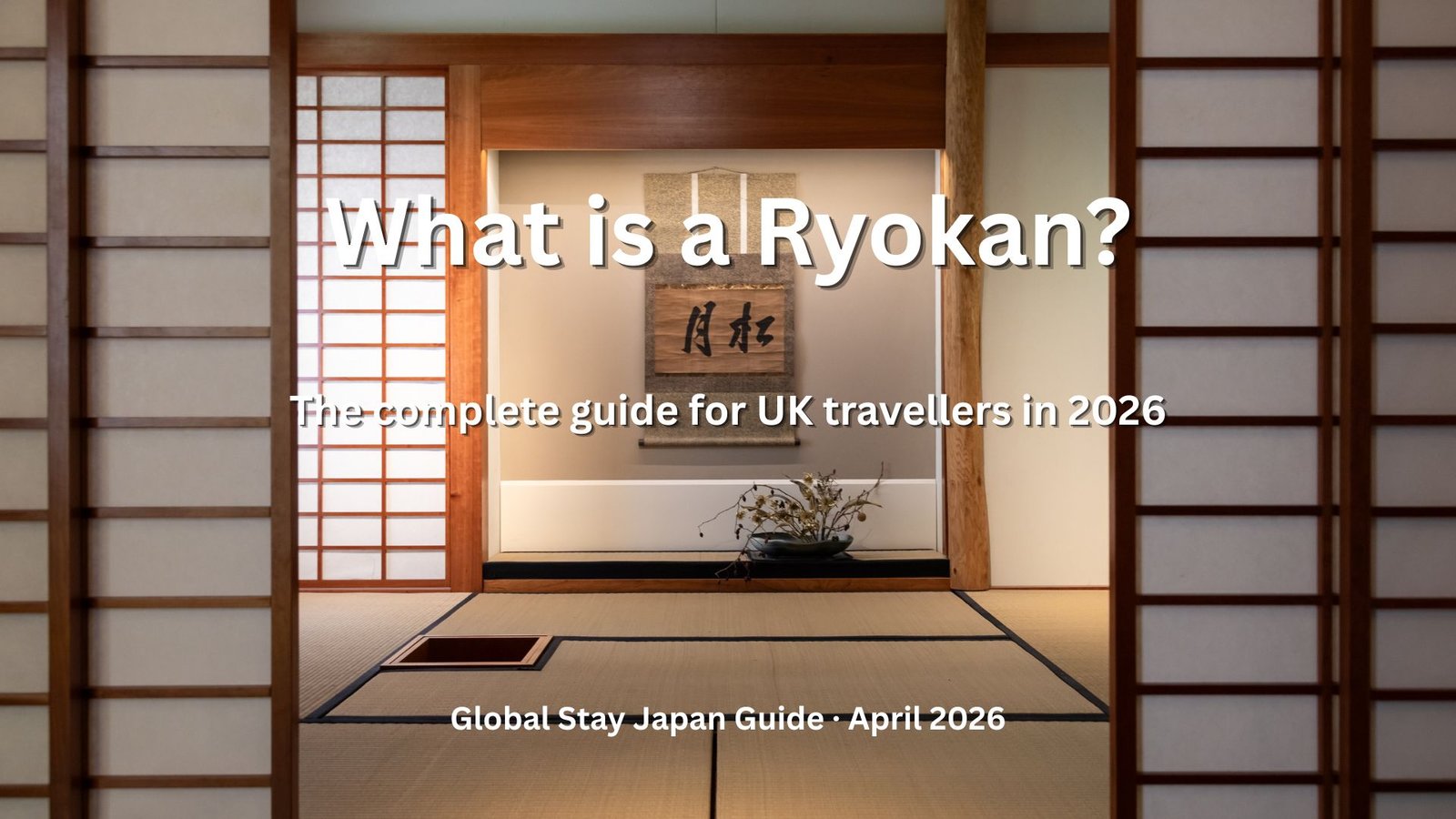
A ryokan (旅館) is a traditional Japanese inn where the room, dinner, breakfast, and bathing facilities are typically included in a single nightly price. Unlike a Western hotel room you return to for sleep, a ryokan room is a living space — tatami flooring, futon bedding laid out by staff each evening, shoji paper screen walls, and in many cases a private or shared onsen hot spring bath. The average ryokan in Japan costs between 15,000 and 30,000 yen per person per night (approximately £75 to £151 at August 2026 exchange rates) with meals included. Luxury ryokan with private open-air onsen baths start from around 40,000 yen per person per night (approximately £189 upwards). All figures are indicative — always request current quotes.
Most UK travel guides describe ryokans in the same handful of sentences: tatami mats, futons, hot springs, Japanese food. That tells you what a ryokan contains but not what it actually feels like, or how to choose one, or what to do when you arrive, or whether it works for travellers with specific dietary requirements. This guide answers all of it — including the sections most UK ryokan articles leave out entirely: GBP pricing, Muslim-friendly options across Japan, how to book from the UK without a Japanese-speaking agent, and when the experience is genuinely worth paying more for versus when a standard Japanese hotel serves you better.
About This Guide
This guide draws on publicly available information from the Japan National Tourism Organisation (JNTO), the Japan Ryokan and Hotel Association (ryokan.or.jp), Booking.com and Agoda Japan listings, HalalTrip.com and FoodDiversity.today for Muslim-friendly ryokan data, and published exchange rate data as of April 2026, rates updated August 2026. All GBP price conversions are approximate based on August 2026 JPY/GBP rates. Exchange rates fluctuate — verify current rates before budgeting.
What is a Ryokan — The Full Explanation
The word ryokan (旅館) translates literally as travel building or inn. Ryokans have been part of Japanese travel culture for centuries, providing weary travellers with a place to rest, bathe, and dine. They were set up in the Edo period (1603-1868) for lords and samurai warriors on the road — after a long day of travelling, the esteemed guests would bathe, enjoy a tea ceremony, and have a long meal washed down with sake.
Today ryokans welcome all guests and represent something hotels cannot replicate: a complete immersion in Japanese domestic culture. You are not staying in a facility. You are staying in a home — a large, meticulously maintained, centuries-old version of a Japanese home where the family’s entire purpose is to make you feel restored.
The essential elements that define every ryokan stay:
- Tatami room — flooring made from woven rush grass. You remove shoes before entering. The room contains a low table, floor cushions, and minimal furniture during the day
- Futon bedding — laid out on the tatami floor by staff each evening while you are at dinner. Packed away each morning. Not the same as a Western futon sofa — a genuine Japanese futon is thick, warm, and remarkably comfortable
- Yukata robe — a lightweight cotton kimono provided in your room. You wear it to dinner, to the onsen, around the building, and to sleep in. The left side always folds over the right — wearing it right over left represents death in Japanese culture
- Kaiseki dinner — a multi-course meal using seasonal local ingredients, served either in a communal dining room or privately in your own room. At traditional ryokan, dinner in your room is the norm
- Japanese breakfast — a completely separate multi-course meal the following morning. Not continental breakfast — grilled fish, rice, miso soup, pickles, egg dishes, and numerous small accompaniments
- Onsen bath — a hot spring mineral bath. Not all ryokan have natural onsen — some use heated water. The distinction matters and is worth checking before booking
- Omotenashi hospitality — the Japanese concept of wholehearted anticipatory hospitality. Staff address your needs before you articulate them. This is not service in the Western transactional sense — it is a philosophy
Types of Ryokan — Which One Is Right for You
The best ryokan for a UK traveller is not automatically the most expensive or the most traditional. It depends entirely on what you want from the stay. Here are the main types:
Onsen ryokan — built around a natural hot spring. The onsen is the centrepiece of the experience. Found primarily in mountain regions: Hakone, Nikko, Kinosaki Onsen, Beppu, Kurokawa, Nyuto Onsenkyo in Akita. The most celebrated ryokan experiences in Japan are almost all onsen ryokan. If you can only stay at one type, this is it.
Traditional inn (hon-ryokan) — the full-service classical experience. Kaiseki dinner in your room, private garden views, tatami throughout, dedicated room attendant (nakai-san). Often housed in buildings several hundred years old. Concentrated in Kyoto, Nara, and historic post-towns like Magome and Tsumago on the Nakasendo trail.
Minshuku — a smaller, family-run ryokan. Less formal, lower price, more personal. The family may cook for you using their own home recipes rather than kaiseki. Budget approximately 8,000 to 15,000 yen per person per night (approximately £38 to £75). The closest Japanese equivalent of a UK B&B.
Urban ryokan — found in Tokyo, Osaka, and Kyoto city centres. Combines tatami rooms and Japanese aesthetics with the practical convenience of a city hotel location. Less likely to have natural onsen but often has hinoki cypress baths. Useful for first-timers who want the ryokan experience without sacrificing city access.
Luxury resort ryokan (ko-inn) — properties like Hoshinoya, Gora Kadan in Hakone, and Amanemu in Mie Prefecture. Private open-air onsen baths (rotenburo) in each room, multi-course meals by named chefs, butler service. Budget from 60,000 yen per person per night (approximately £283 upwards) and rising well beyond that at peak periods. Worth it for a special occasion — not your base option for a standard 10-day Japan itinerary.
Japanese-Western hybrid ryokan — rooms with Western beds and tatami seating areas, combining Japanese aesthetics with more familiar sleeping arrangements. The right choice for travellers with back conditions who cannot sleep on floor-level futon, or for families with young children who need cot-accessible rooms.
What Does a Ryokan Cost in GBP for UK Travellers?
This is the section most UK ryokan guides either omit entirely or bury in a footnote about exchange rates. Here are indicative GBP price ranges per person per night including dinner and breakfast at the time of writing, converted from JPY at approximately £1 = ¥212 (August 2026). Exchange rates change — verify before budgeting.
- Budget minshuku (family-run, basic facilities) — approximately £38 to £75 per person per night
- Mid-range onsen ryokan (private or shared onsen, tatami rooms, kaiseki) — approximately £75 to £151 per person per night
- Upper mid-range traditional ryokan (Kyoto, Nara, Hakone, dedicated room attendant) — approximately £151 to £255 per person per night
- Luxury resort ryokan (private open-air onsen per room, named chef kaiseki) — approximately £255 to £566 per person per night
- Ultra-luxury (Hoshinoya, Gora Kadan, Amanemu) — approximately £566 and above per person per night
All prices are indicative, per person (not per room), and include dinner and breakfast unless stated otherwise. Prices vary by season, booking channel, and specific property. Always request a current quote. JPY/GBP rates change daily.
The mid-range onsen ryokan represents the best value entry point for most UK first-timers — it delivers the tatami rooms, kaiseki dinner, Japanese breakfast, and onsen bath that define the experience, without the luxury supplement of private in-room baths.
How a Ryokan Stay Actually Works — Step by Step for UK Visitors
The sequence of a ryokan stay follows a defined rhythm that is consistent across most properties. Knowing it in advance removes the anxiety of arriving somewhere unfamiliar without knowing what comes next.
Arrival (check-in typically 3:00pm to 4:00pm): You remove shoes at the entrance (genkan) and are given slippers. A member of staff — often the nakai-san room attendant — bows and escorts you to your room. Green tea and wagashi sweets are waiting. Your room is a living space at this point — the futon is not yet out.
Settling in (4:00pm to 6:00pm): Yukata and towels are in the wardrobe. Change into your yukata. Explore the building, the gardens, and the onsen bathing areas. The onsen is used before dinner — the sequence at a ryokan is arrive, bathe, dine, sleep, bathe again (optional), breakfast.
Onsen bathing: Men and women bathe separately in most shared onsen unless you book a private bath (kashikiri-buro). You wash thoroughly at the shower stations before entering the bath — the onsen is for soaking, not washing. Tattoos are prohibited at most onsen in Japan due to historical association with organised crime. If you have visible tattoos, book a private bath or check the policy before choosing your ryokan. Bathing is naked in communal onsen. Taking your first Japanese-style bath can seem bewildering at first, but the principle is always the same, whether using an onsen or a private bath in your room.
Dinner (typically 6:00pm to 7:00pm): Either in your room (traditional) or in a communal dining area (common at larger properties). A ryokan stay typically includes a kaiseki ryori (formal, multi-course) dinner and traditional Japanese breakfast the next morning. Your meticulously presented meals are cooked using local, seasonal ingredients. Dinner takes 60 to 90 minutes. Sake, beer, and non-alcoholic drinks are available — at Muslim-friendly ryokan, alcohol-free options are standard.
Overnight: While you dine, staff enter your room and lay out the futon on the tatami. You return to a prepared sleeping space. The room temperature is controlled. Everything is quiet.
Breakfast (typically 7:30am to 8:30am): A second multi-course meal — savoury, traditional Japanese. Grilled fish, rice, miso soup, pickled vegetables, tofu, and eggs in various preparations. Very different from a Western hotel breakfast. Most UK guests consider it one of the highlights of the stay.
Check-out (typically 10:00am to 11:00am): Earlier than Western hotels. The ryokan needs time to prepare rooms for the next evening’s guests. Plan your Japan itinerary around this constraint — most sightseeing in Japan begins by mid-morning anyway.
Muslim-Friendly Ryokans in Japan — The UK Traveller’s Guide
This section exists in almost no UK ryokan guide — which is precisely why it matters. Japan’s Muslim tourism infrastructure has improved substantially by 2026, and a growing number of ryokan now offer halal-certified or Muslim-friendly services.
The key questions for UK Muslim travellers booking a ryokan:
Halal food at ryokan: Some higher-end ryokan can prepare halal versions of their meals with advance notice — always confirm when booking. A number of ryokan have obtained formal halal certification from the Japan Islamic Trust or equivalent bodies. Muslim-friendly ryokan typically offer halal kaiseki alternatives or separate halal menus. At ryokan without halal certification, vegetarian kaiseki is often available as an alternative — this removes meat and fish concerns but does not address alcohol in cooking, which is common in standard Japanese cuisine.
Prayer facilities: Muslim-friendly ryokan increasingly provide prayer mats, Qibla direction markers, and Qibla compasses in rooms as standard. Risshisha Machiya in Kyoto equips every room with prayer mats, the Qibla mark, Qibla compass, prayer clothes, and special tableware for Muslim guests, alongside a halal menu approved by the Japan Islamic Trust.
Private onsen for Muslim guests: Communal naked bathing in mixed-gender settings is incompatible with Islamic modesty requirements. Many Muslim-friendly ryokan offer kashikiri-buro — reserved private family baths — at no extra charge or for a small fee. Some ryokan offer private onsen baths specifically suitable for Muslims or any guests who do not wish to bathe in communal settings.
Halal-certified ryokan worth knowing for UK Muslim travellers:
- Risshisha Machiya, Kyoto — halal menu approved by Japan Islamic Trust, prayer facilities in all rooms, central Kyoto location near Kyoto Station
- Satoyu Mukashibanashi Yuzanso, Shiga Prefecture — halal-certified dinner, Muslim staff member, near Lake Biwa, approximately 20 minutes from Kyoto
- Naruko Onsen Ryokan Bentenkaku, Miyagi — halal meals, private onsen available, Tohoku region
- Spa Village Kamaya, Nikko, Tochigi — halal menu using local ingredients including yuba and fish, family private bath included at no extra charge
- Hotel and Ryokan Ayunosato, Kumamoto, Kyushu — first halal-certified accommodation in Kumamoto Prefecture, halal wagyu beef, private in-room hot spring
For the most current and comprehensive list of Muslim-friendly ryokan in Japan, the Halal In Japan platform (halalinjapan.com) maintains an updated directory searchable by region.
Where to Stay — Best Ryokan Regions for UK Travellers
Japan has over 80,000 ryokan across all 47 prefectures. For UK first-timers, these regions offer the best combination of accessibility and authentic experience:
Hakone (Kanagawa Prefecture) — the most accessible onsen ryokan destination from Tokyo. Two hours by Romancecar train from Shinjuku Station. Gora Kadan in Hakone National Park, the former retreat of the Kan’in-no-miya imperial family, takes relaxation seriously with a whirlpool Jacuzzi, open-air hot springs and suites with private stone baths. Views of Mount Fuji from select rooms and outdoor baths on clear days. Price range from mid-range to ultra-luxury. The ideal one-night ryokan add-on to a Tokyo itinerary.
Kyoto — the most culturally significant ryokan destination. Traditional machiya townhouse ryokan, formal inn-style properties in the Higashiyama district, and urban luxury ryokan near Gion. The combination of Kyoto temples, geisha districts, and centuries-old ryokan architecture is unmatched anywhere in Japan. Best for travellers who want both cultural sightseeing and an authentic inn experience in the same base.
Kinosaki Onsen (Hyogo Prefecture) — a traditional hot spring town where guests wear yukata to stroll between seven public bathhouses in the evening. One of the most atmospheric ryokan destinations in Japan. Approximately 2.5 hours from Kyoto or Osaka by direct train. Mid-range pricing — very accessible for UK visitors on a standard Japan budget.
Nikko (Tochigi Prefecture) — two hours from Tokyo, home to some of Japan’s most ornate temple architecture alongside mountain onsen ryokan. Strong Muslim-friendly options in the Nikko area. Best for travellers combining cultural sightseeing with onsen.
Hokkaido — Japan’s northern island. Winter onsen ryokan with snow landscapes are the signature experience. Noboribetsu Onsen, Jozankei, and Sounkyo Gorge are the principal ryokan destinations. Best for UK travellers visiting Japan in December through February who want both snow activities and a restorative ryokan stay.
Nara — historic capital city with traditional ryokan near Nara Park (home to the freely roaming deer) and Todai-ji Temple. Quieter and less expensive than Kyoto. Nara is one of the prestigious locations where classic ryokan experiences can be found alongside the old capitals’ cultural heritage.
Ryokan Etiquette — What UK Travellers Need to Know
Arriving at a ryokan without knowing the basic etiquette is the single most common cause of first-timer anxiety. These are the rules that actually matter:
Shoes off at the entrance. Always. The genkan entrance step is the line between outside and inside. Never cross it wearing outdoor shoes. Slippers are provided.
Slippers off on tatami. The room itself has a different level. Remove the slippers before stepping onto the tatami floor area. Walking on tatami in slippers damages it.
Separate toilet slippers. Many ryokan have a different pair of slippers for the toilet area. Put them on when entering, take them off when leaving. Forgetting to swap is the most frequently made mistake — even by Japanese guests.
Yukata worn left over right. The left side of the robe folds over the right side when looking down. Right over left is how the deceased are dressed in Japan. This is taken seriously.
Onsen before dinner, not after. The Japanese bathe before eating, not after. This is not a rigid rule that staff will enforce but it is the cultural expectation and the experience is significantly better in the correct order.
No tattoos in most onsen. Japanese law and longstanding cultural convention prohibits tattooed guests from communal onsen. Some progressive ryokan have relaxed this policy, but most have not. If you have visible tattoos, book a private kashikiri-buro bath and confirm the policy before arrival.
Dinner time is fixed. Unlike hotel restaurants, ryokan dinner is served at an agreed time set at check-in. Missing it without advance notice is disruptive to the kitchen and considered disrespectful to the staff. Confirm your dinner time on arrival and keep to it.
How to Book a Ryokan from the UK
Booking a ryokan from the UK is more complex than booking a standard hotel. Three things make it different:
First, many smaller traditional ryokan have Japanese-only websites and do not accept direct online bookings from non-Japanese speakers. Often their websites are also only in Japanese, the information is limited, and many of the smaller properties can only be booked via fax. This was largely true as recently as 2024. By 2026, the situation has improved — Booking.com Japan, Rakuten Travel, and Jalan list many ryokan in English — but genuinely traditional properties in rural areas often still require a Japanese-speaking intermediary.
Second, ryokan stays are priced per person including meals, not per room. The booking process requires you to specify dietary requirements, meal plan preferences, and room type at the time of booking — not on arrival. A last-minute dietary requirement communicated at check-in, particularly for halal meals, is very difficult for a ryokan kitchen to accommodate. Always communicate requirements in advance.
Third, Japanese-language review platforms (particularly Jalan and Ikyu) carry significantly more ryokan reviews than any English platform. A ryokan with 12 TripAdvisor reviews may have 2,000 reviews on Jalan. If you want a complete picture of guest experience before booking, you need access to the Japanese platforms — which is another reason a UK booking service with Japan experience adds genuine value.
Global Stay sources ryokan and Japan hotels for UK travellers directly. Submit a quote request with your Japan travel dates, preferred regions, budget per person per night, meal requirements (including any halal, vegetarian, or other dietary needs), and whether you want private or shared onsen. We research options across our supplier network and respond within 24 hours with matched ryokan options and current pricing in GBP.
Ryokan vs Standard Hotel in Japan — When to Choose Which
A ryokan stay is not always the right choice for every night of a Japan trip. Here is when each serves you better:
Choose a ryokan when you want a cultural experience, when you are based in a hot spring town or mountain resort area, when you have a special occasion or anniversary, when you want an all-inclusive evening with meals included, and when you are spending two or more nights in one place.
Choose a standard Japan hotel when you need maximum flexibility for meal times (business travel or late arrivals), when you are moving every night and carrying luggage extensively, when budget is the primary constraint (city business hotels in Japan start from approximately £57 per room per night and deliver excellent value), and when you have back conditions that make floor-level futon sleeping impractical.
The ideal Japan itinerary for most UK visitors combines both: standard city hotels in Tokyo and Osaka for the urban legs, and one to three ryokan nights in Hakone, Kyoto, or Kinosaki Onsen for the cultural experience. This approach delivers both city convenience and the ryokan moments that every UK visitor remembers most.
🌸 Planning your Japan trip? Book Japan tours and experiences on Klook including Kyoto temples, Tokyo day trips and cultural activities. Get a Japan eSIM on Airalo — data from day one without roaming costs. Book airport transfers across Japan on Kiwitaxi.
Glossary — Ryokan and Japan Hotel Terms UK Travellers Should Know
Ryokan (旅館) — a traditional Japanese inn. Typically includes tatami rooms, futon bedding, kaiseki dinner, Japanese breakfast, and onsen bathing facilities in a single nightly rate priced per person. See our best ryokans Kyoto guide for specific properties.
Onsen (温泉) — a natural hot spring mineral bath. Water temperature typically 38 to 45°C. Mineral composition varies by location and is believed to have therapeutic properties. Not all ryokan have natural onsen — some use heated tap water. Check before booking if natural onsen matters to you.
Rotenburo (露天風呂) — an outdoor open-air onsen bath. The most celebrated type of onsen experience — bathing in thermal water surrounded by mountain, forest, or garden scenery, often in snow during winter.
Kashikiri-buro (貸切風呂) — a private reserved onsen bath for exclusive use by one group. Bookable in advance or at check-in. Essential for Muslim travellers, families with young children, or guests with tattoos. Usually 45 to 60 minutes per booking.
Kaiseki (懐石) — a multi-course Japanese meal using seasonal and local ingredients. The highest form of Japanese culinary tradition. At ryokan, kaiseki dinner typically consists of 8 to 12 courses including appetiser, soup, sashimi, grilled dish, simmered dish, rice, pickles, and dessert.
Tatami (畳) — woven rush grass flooring used in traditional Japanese rooms. Cool in summer, slightly warm in winter. Shoes and slippers must be removed before stepping on tatami.
Futon (布団) — thick padded floor-level bedding laid out on tatami each evening by ryokan staff. Not the same as a Western futon sofa. Traditional Japanese futon is surprisingly comfortable and warm.
Yukata (浴衣) — a lightweight cotton casual kimono provided at ryokan for guests to wear throughout their stay. Left side always folds over right.
Omotenashi (おもてなし) — the Japanese concept of wholehearted anticipatory hospitality. The philosophy underpinning all ryokan service — not transactional, but an expression of genuine care for the guest’s wellbeing.
Nakai-san (仲居さん) — a room attendant at a traditional ryokan, typically a woman in traditional dress. Responsible for preparing your room, serving your meals, and attending to your needs throughout your stay.
Minshuku (民宿) — a smaller, family-run Japanese inn. Less formal than a full ryokan. Lower price, more personal atmosphere. The closest Japanese equivalent to a UK B&B.
Machiya (町家) — a traditional Japanese townhouse. Some Kyoto machiya have been converted into intimate ryokan-style accommodation combining historic wooden architecture with contemporary amenities.
Hanare (離れ) — a detached private villa within a ryokan complex. The most private and premium room type — a standalone building separate from the main inn, often with a private garden and private open-air onsen.
Frequently Asked Questions — What is a Ryokan
What is a ryokan in Japan?
A ryokan is a traditional Japanese inn where the room, dinner, breakfast, and bathing facilities are typically included in a single per-person nightly rate. The room has tatami straw mat flooring and futon bedding laid out each evening by staff. Most ryokan have onsen hot spring baths. The experience is built around omotenashi — a Japanese philosophy of wholehearted hospitality that anticipates and attends to every guest need without being asked. For specific property recommendations, see our Kyoto ryokan guide.
How much does a ryokan cost from the UK in GBP?
Based on approximate August 2026 JPY/GBP exchange rates, a mid-range onsen ryokan with dinner and breakfast included costs approximately £75 to £151 per person per night. Budget minshuku cost from approximately £38 per person per night. Luxury resort ryokan start from approximately £255 per person per night and rise well above £566 at ultra-premium properties. All figures are indicative — verify current rates and exchange rates before budgeting. Request a current quote from Global Stay.
Can Muslim travellers stay at a ryokan in Japan?
Yes — and the options have improved significantly by 2026. A number of ryokan now offer halal-certified menus, prayer facilities (prayer mat, Qibla direction, prayer clothes), and private onsen baths suitable for Muslim guests who cannot use communal naked bathing facilities. Notable Muslim-friendly ryokan include Risshisha Machiya in Kyoto, Satoyu Mukashibanashi Yuzanso near Lake Biwa, and several properties in the Nikko area. Always confirm halal certification and private bath availability before booking.
Is a ryokan suitable for children?
Yes — most ryokan welcome families and children. Japanese-Western hybrid rooms with elevated beds rather than floor-level futon are available at many properties for families with very young children. Dinner in your room means no restaurant behaviour concerns. The main consideration is onsen etiquette — young children in communal baths are generally fine but teenagers may prefer private baths.
What is the difference between a ryokan and a minshuku?
A ryokan is a formal traditional Japanese inn with professional staff, kaiseki dining, and comprehensive facilities including onsen. A minshuku is a smaller, family-run inn with a more informal, home-like atmosphere. Minshuku meals are home-cooking rather than formal kaiseki, and facilities are simpler. Minshuku cost approximately £38 to £75 per person per night — significantly less than a full ryokan. For UK travellers on a tighter budget or seeking a more personal local experience, minshuku offer excellent value.
Do you need to speak Japanese to stay at a ryokan?
Not at most ryokan listed on English-language platforms like Booking.com Japan, Agoda, or through specialist UK booking services. Major ryokan in popular tourist areas (Hakone, Kyoto, Nikko) have English-speaking staff. At smaller, more traditional rural properties, limited English is common but staff compensate through attentiveness and non-verbal communication. Booking through a UK service that communicates dietary requirements and special requests in advance — ideally in Japanese — removes the main language barrier points entirely.
Can I book a ryokan without meals included?
Some ryokan offer room-only or bed-and-breakfast rates, particularly urban ryokan. However, the kaiseki dinner is considered an essential part of the traditional ryokan experience — booking without it misses the cultural centrepiece of the stay. For Muslim travellers who cannot eat the standard kaiseki menu and whose specific halal requirements cannot be met by a particular property, a room-only rate at a Muslim-friendly property with nearby halal restaurants may be the practical choice. Discuss this at the time of enquiry. Contact Global Stay to discuss your requirements.
How do I book a ryokan from the UK?
You can book directly through Booking.com Japan, Agoda, or Rakuten Travel for larger, internationally-oriented properties. For traditional or rural ryokan, particularly those requiring dietary requirement communication in Japanese, using a UK-based Japan hotel specialist is strongly recommended. Global Stay sources ryokan for UK travellers — submit a quote request with your Japan dates, preferred regions, budget, and meal requirements and we respond within 24 hours.
🌸 Book Japan Tours and Experiences
Kyoto temples, Tokyo day trips, tea ceremonies, bullet train experiences and more — book in advance to avoid selling out
Hotels Near Haram Makkah — Distance and Zone Guide 2026
Umrah Cost from UK 2026 — Complete Hotel Price Breakdown
Hotels in Madinah Near Masjid An-Nabawi
Get a Personalised Japan Hotel or Ryokan Quote
Written by the Global Stay Editorial Team. Global Stay is a UK registered hotel booking service operated by Ya-Fatahoo Solutions Limited (Company No: 16175087), incorporated in England and Wales. We source ryokan and Japan hotels for UK travellers alongside Makkah, Madinah, and worldwide hotel destinations. Submit a quote request at globalstay.co.uk and we respond within 24 hours.
Editorial policy: All pricing data and facility information are based on publicly available sources as of April 2026, exchange rates updated August 2026. Prices and exchange rates change frequently — always verify current rates before budgeting or booking.
Pricing accuracy: All ryokan rates and GBP price estimates are indicative ranges based on publicly available information as of April 2026, rates updated August 2026. Prices change frequently. No price stated constitutes a quotation, offer, or guarantee. Always obtain a current written quote before making any financial commitment.
Exchange rates: All GBP prices are converted from JPY at approximate August 2026 rates (£1=¥212). JPY/GBP exchange rates fluctuate daily. The real GBP cost of a Japan ryokan at the time of your travel may differ materially from figures in this guide. Always verify current exchange rates before budgeting.
Halal certification: Halal certification status of named ryokan is based on publicly available information as of April 2026, rates updated August 2026 and may change. Always verify current halal certification, prayer facility availability, and private bath arrangements directly with the ryokan before booking. Global Stay accepts no responsibility for changes to a property’s halal status after the date of this guide.
Tattoo policies: Onsen tattoo policies vary by property and are subject to change. The information in this guide reflects general practice in Japan as of August 2026. Always verify a specific ryokan’s current tattoo policy before booking.
UK consumer rights: This guide is for informational purposes only and does not constitute a regulated financial promotion or consumer contract. Global Stay is not an ATOL holder. For flight-inclusive travel ensure your provider holds valid ATOL protection.
FTC disclosure (US readers): This guide may contain affiliate links. If you click a link and make a booking, Global Stay may earn a commission at no additional cost to you.
For informational purposes only. Does not constitute legal, financial, medical, or religious advice. Last updated: August 2026.